The Future of Business Wallets
Our GDC 2026 recap from Geneva
Last week we attended GDC 2026 in Geneva, where sessions on Business Wallets, AI agents, supply chains and digital sovereignty explored the future of digital trust.
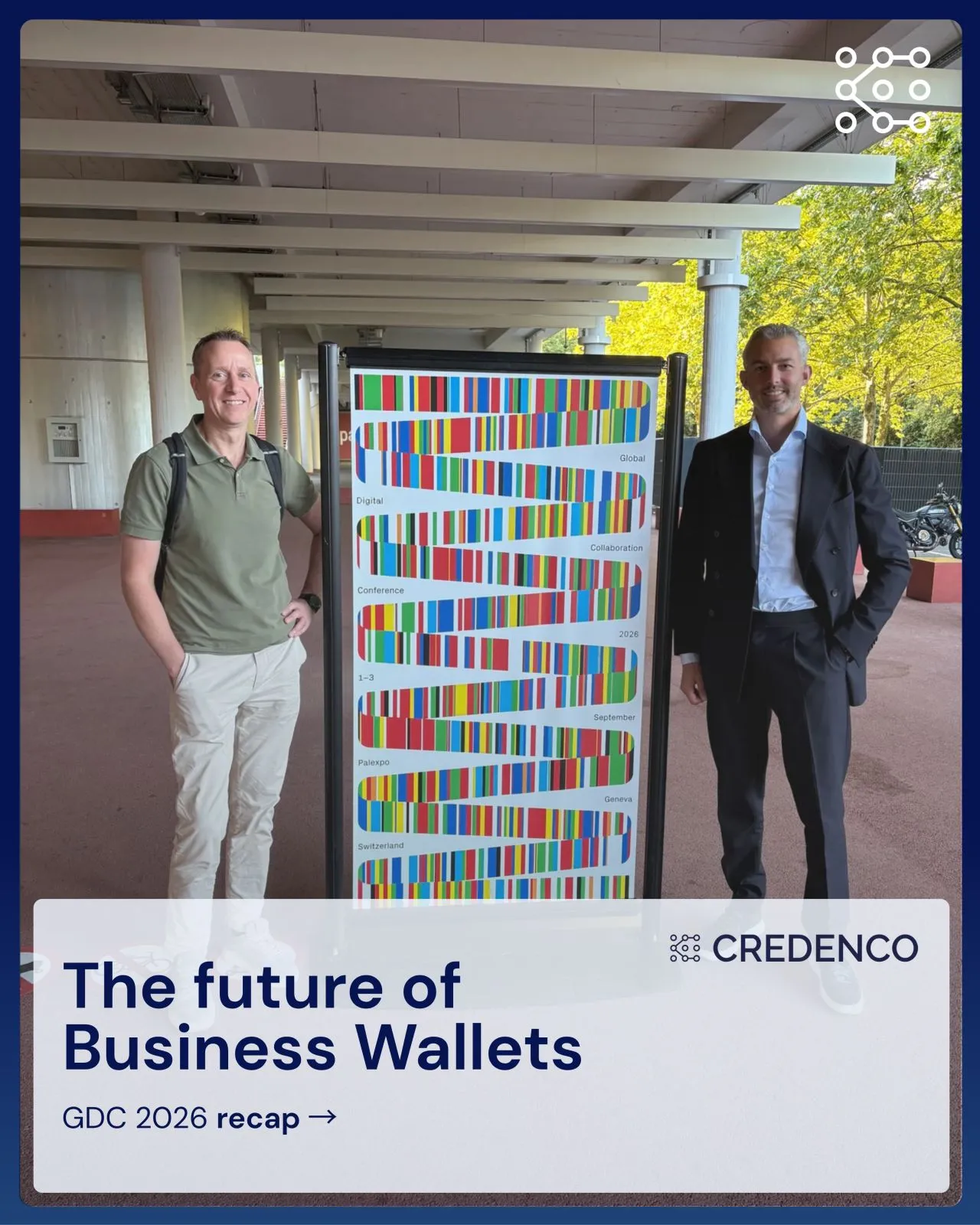
What happens when Business Wallets, AI agents, global supply chains and digital sovereignty come together?
Last week, we attended GDC 2026 in Geneva, where presentations, live demonstrations and conversations explored the future of digital trust.
The discussion is moving beyond what a digital wallet is to how wallets operate across organisations, jurisdictions, technology providers and autonomous processes.
Sessions highlighted how European Business Wallets can support corporate identity, KYB/KYC, payments and trusted B2B interactions. The BU1 use cases with Bosch, Swiss Federal Railways SBB, Bundesanzeiger Verlag GmbH, Spherity and Procivis demonstrated how this infrastructure is taking shape in real business environments.
The UN Transparency Protocol showed another powerful application: following cotton from a farm to a finished garment in a European store, demonstrating the potential of verifiable data for supply-chain transparency and traceability.
AI agents added a further dimension, from wallet-assisted onboarding to agents acting through Business Wallets and pre-authorised mandates. As technical capabilities advance, legal authority, accountability, governance and trust must advance with them.
These themes connected directly to Credenco's work. During the WE BUILD Consortium session, "A company has no fingers: why the European Business Wallet is not a personal wallet at scale", Eelco Klaver shared findings from the WE BUILD architecture team and its Large Scale Pilot.
A company acts through employees, representatives, delegated authorities and automated systems. Business Wallets therefore need to support governance, representation, delegation, machine-to-machine interactions and organisational authority.
Live demonstrations made this tangible. interID and Animo Solutions demonstrated business onboarding across four technology stacks, combining LPIDs, PIDs, QTSP seals and electronic signatures.
We also heard perspectives on digital sovereignty, interoperability, EUDI Wallets, European Business Wallets, intermediaries, WE BUILD, APTITUDE, ETSI and CEN, alongside trust and governance for AI agents.
The challenge is clear: organisations should not need to become experts in every wallet protocol, credential format, trust list and regulatory framework. Solutions need to absorb that complexity and fit existing business processes. That is exactly the challenge we are working on at Credenco.
We ended the week with a private tour of CERN, an inspiring reminder of what international collaboration can achieve.
Thank you to the FIDES Community, the speakers, participants and everyone we met for the excellent conversations. We returned from Geneva with new insights, connections and ideas to follow up on.
Share this item
If you want to share this item to your socials or via mail click the button below.
Want to know more?
Curious about how this applies to your organisation, or want to talk to us about a specific use case? Get in touch. We're happy to help.